
The RISE Framework — Your Positive Psychology Toolkit
8 min · Read
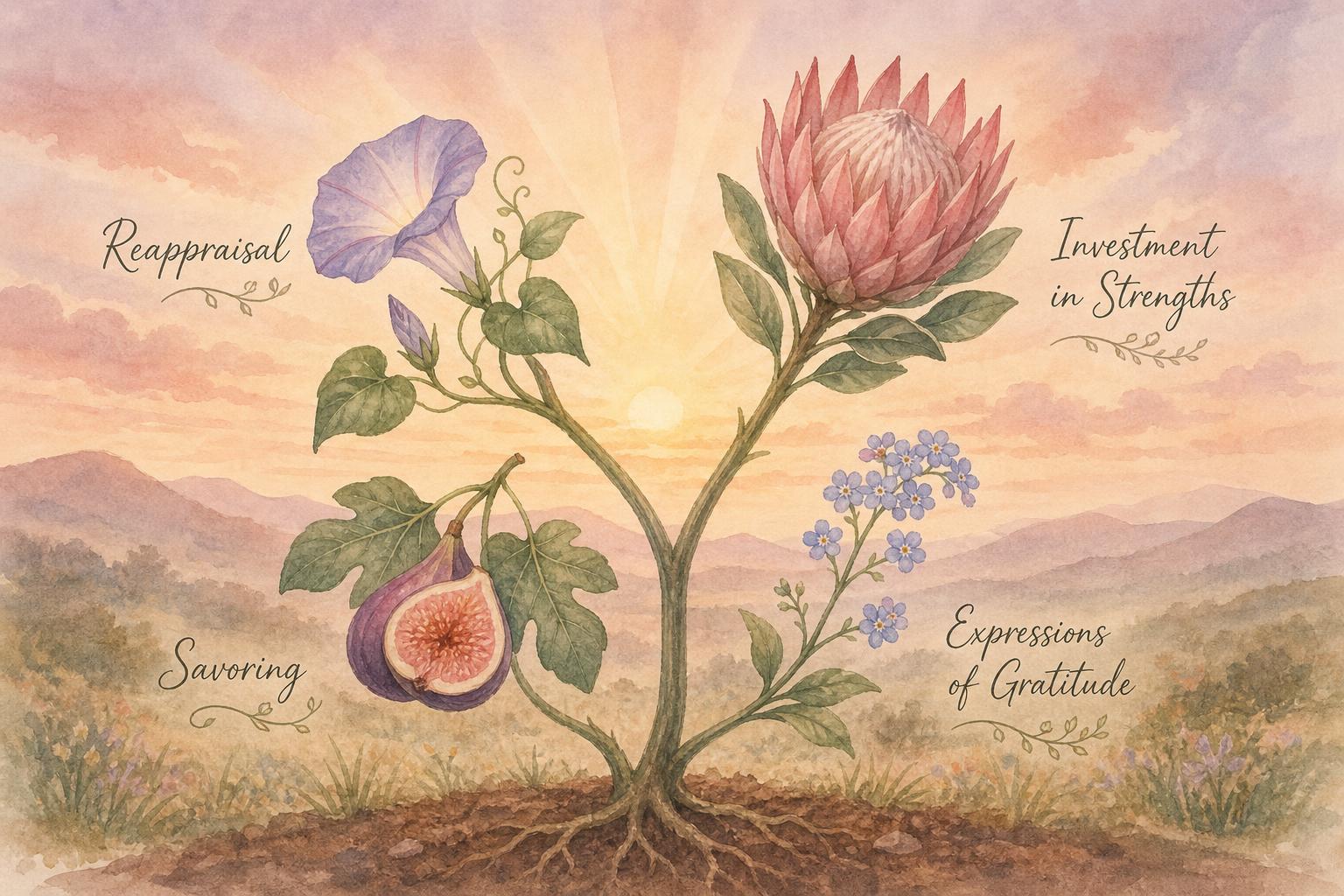
The four evidence-based practices you'll use across all four modules: Reappraisal, Investment in Strengths, Savoring, and Expressions of gratitude.
★ These are not passive ideas. They are practices — things you do. The research on each element is based on people who actually engaged with them regularly, not just read about them.
Throughout the WHIM program, you will encounter a set of four evidence-based positive psychology practices drawn from the work of researchers including Dr. Judith Moskowitz (Northwestern University) and Dr. Joanne Addington. Together, we call these the RISE framework.
S — Savoring
Savoring means deliberately noticing, appreciating, and extending positive experiences. In a world that moves fast — and during a transition that can feel relentlessly challenging — savoring is the practice of slowing down to let the good in.
- Pause and fully attend to a pleasant experience as it is happening
- Use all your senses to absorb it
- Share it with someone — social sharing amplifies the positive effect
- Take 'mental photographs' — revisit positive memories deliberately
A — Expressions of Gratitude
You have already been introduced to gratitude. In the RISE framework, appreciation extends gratitude to include a broader orientation toward what is present and valuable — in your body, your relationships, your life, and even this challenging transition.
G — Reappraisal
Positive reappraisal means finding a different, more constructive way of understanding a difficult situation — without denying its difficulty. It is the practice of asking: 'What else might be true here? Is there any way this experience is contributing to my growth?'
- Not the same as silver-lining thinking or toxic positivity
- Based on research showing that how we interpret events has measurable effects on stress hormones, immune function, and wellbeing
- Example: 'This hot flash is miserable' (true) AND 'It is a reminder that my body is going through something significant that deserves care' (also true)
E — Investment in Strengths
The VIA (Values in Action) Character Strengths framework, developed by Dr. Martin Seligman and Dr. Christopher Peterson, identifies 24 universal human strengths that exist on a spectrum in every person. Research shows that identifying and intentionally using your top strengths is associated with:
- Greater engagement and sense of meaning
- Increased resilience during difficult periods
- Improved mood and reduced stress
You will take the free VIA survey as part of the written practices in this module and identify your personal top strengths.
Watch
A structured overview of all four RISE elements with clear examples of each applied specifically to the menopause experience. Bridges the RISE practices to the medical content already covered. Ends with: 'You now have both the medical foundation and the psychological toolkit. Let's put them together.'
Reflect
Of the four RISE elements — savoring, appreciation/gratitude, growth/reappraisal, and strengths — which resonates most with you right now?
Tip: highlight any passage to save it to your notes board in the Log.